
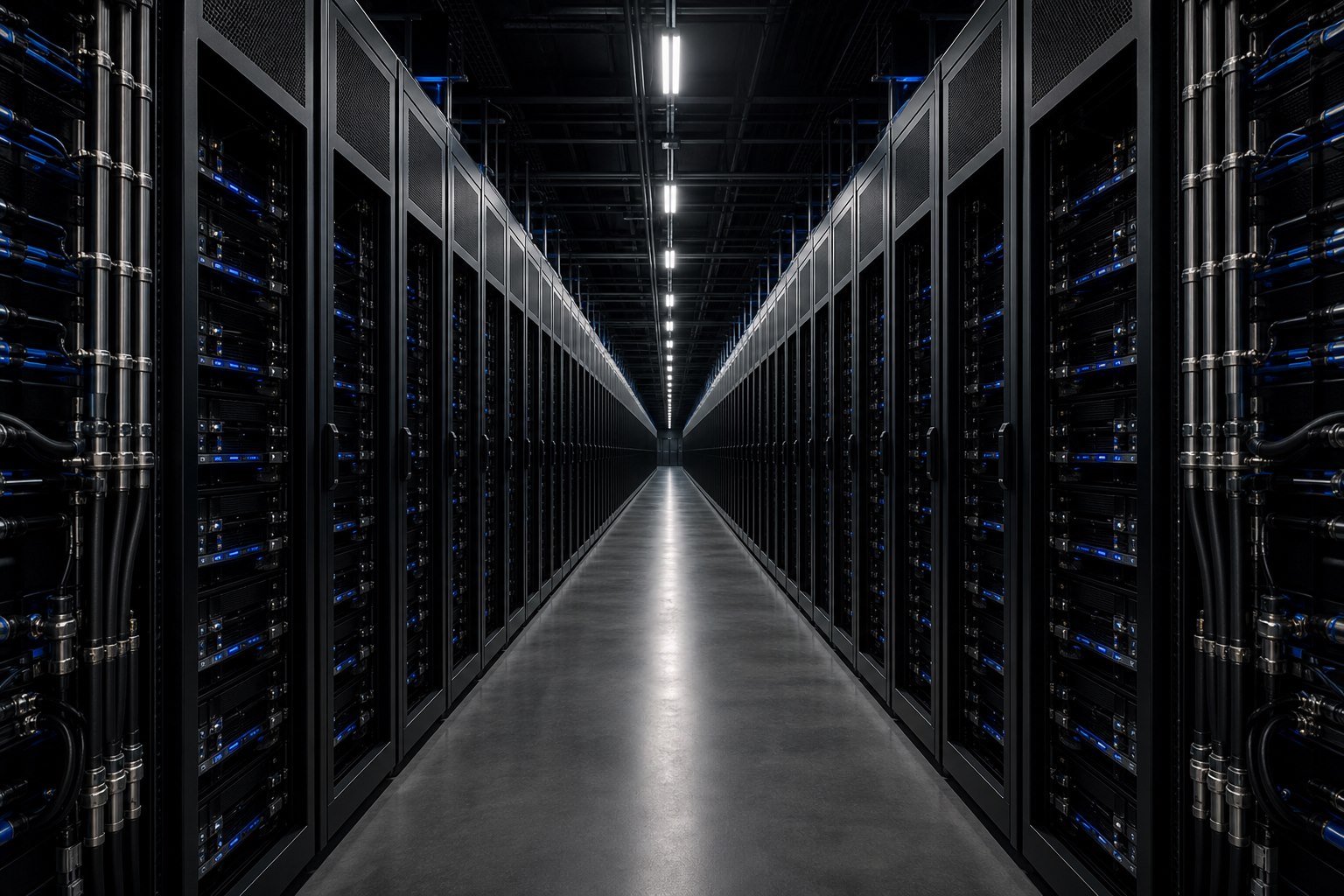
The physical infrastructure constraints that increasingly determine AI compute strategy, deployment speed and long-term operating performance.
Artificial intelligence strategy is becoming infrastructure strategy. Model ambitions may begin with accelerators, software and data, but the ability to deploy meaningful compute capacity is increasingly determined by electrical supply, thermal architecture, network topology and the physical readiness of the site.
This shift changes the sequence of decisions. Compute can no longer be planned first and housed later. High-density systems create requirements that reach upstream into utility connections and substations and downstream into cooling distribution, controls and facility operations. The infrastructure architecture must develop with the compute architecture.
Power availability is not power readiness
A site may have an attractive utility allocation and still be years away from supporting an AI deployment. The usable capacity depends on voltage level, interconnection work, redundancy targets, transformer availability, distribution topology and the dynamic behavior of the load. Rapid changes in accelerator utilization can also produce load characteristics that conventional planning assumptions do not fully capture.
A credible capacity plan distinguishes contracted power, deliverable power and IT power. It maps the losses and reserves between them and makes the phasing logic explicit. This prevents headline megawatts from becoming a substitute for engineering readiness.
Cooling has become a technology roadmap decision
Air cooling remains appropriate for many environments, but rising rack density is making liquid cooling a central design consideration. Direct-to-chip systems, coolant distribution units, facility water loops and heat rejection equipment introduce new interfaces and new operational skills. The correct architecture depends on both today's hardware and the expected density path of future generations.
Overbuilding every system for a theoretical maximum is expensive. Underbuilding locks the facility into an early ceiling. A modular thermal strategy creates defined zones, repeatable distribution blocks and expansion points that can absorb new equipment without redesigning the entire plant.
Density is a system property
Rack density is often discussed as if it were an isolated technical figure. In practice it is the result of coordinated limits across busways, cables, floor loading, coolant distribution, network access, maintenance clearances and failure behavior. Increasing one limit does not create usable density if another interface remains fixed.
The most useful design metric is not the maximum density of one rack. It is the density that can be deployed repeatedly, operated safely and supported across the facility under realistic redundancy conditions.
AI infrastructure wins when power, cooling, network and compute evolve on one coordinated roadmap.
Build a platform, not a one-generation facility
AI hardware cycles move faster than infrastructure cycles. Facilities designed around one specific generation risk becoming constrained before their financial life is complete. The alternative is not technology neutrality in the abstract. It is a deliberate platform architecture with modular capacity blocks, explicit interface standards and an operating model that can incorporate change.
TERAVEX coordinates compute requirements with energy systems, thermal infrastructure and delivery partners. This integrated view helps organizations understand the physical consequences of their AI strategy before those consequences become schedule and capital constraints.
Infrastructure intelligence for energy, compute and industry.