
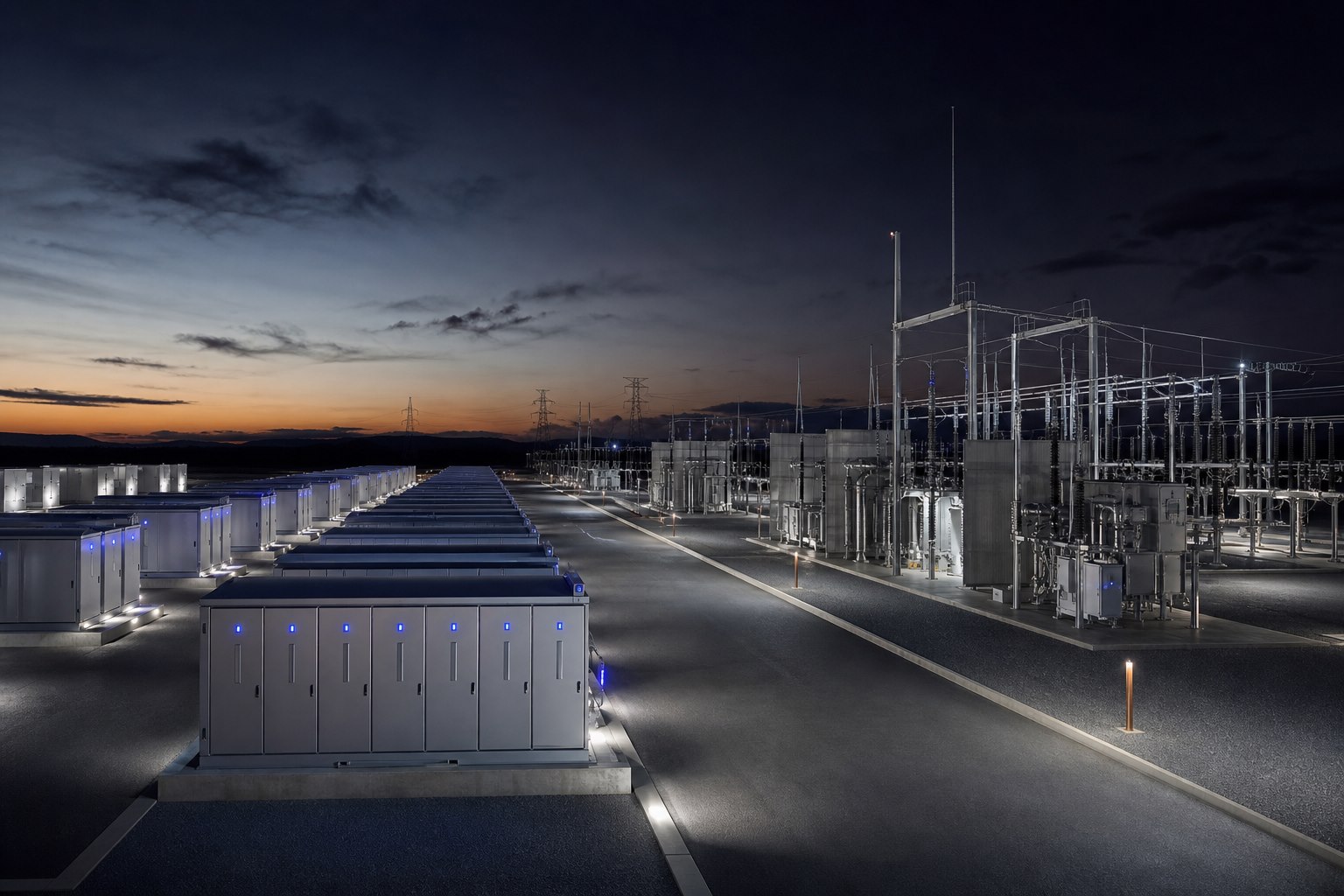
Why utility-scale storage succeeds when grid strategy, controls, equipment and lifecycle operations are planned as one system.
Battery energy storage has moved from a specialist technology to a central element of modern power infrastructure. Utilities use storage to stabilize networks and integrate variable generation. Industrial operators use it to manage demand, preserve critical loads and create flexibility around constrained grid connections. Data center developers increasingly evaluate storage alongside generation, substations and backup power as part of one capacity strategy.
Yet many storage programs are still organized as equipment purchases. Capacity and duration are specified, suppliers are compared and integration questions are deferred until a preferred product has been selected. That sequence appears efficient, but it places the most consequential decisions—the grid interface, control hierarchy, operating strategy, safety concept and lifecycle model—after the project has already narrowed its choices.
The next generation of battery infrastructure requires a different operating model. Storage must be treated as an integrated power system whose value is created by the coordination of physical equipment, software, network conditions and long-term operations.
Begin with the function, not the container
A megawatt and megawatt-hour rating does not describe how a storage asset must behave. Two systems with identical nameplate capacity can require completely different architectures depending on whether the objective is peak reduction, energy arbitrage, frequency response, islanding, renewable firming or resilience for a critical facility.
The operating objective determines cycling behavior, response time, reserve requirements, degradation assumptions and the relationship between local controls and external market or grid signals. It also determines which performance guarantees are meaningful. Defining these conditions early allows technology selection to follow the commercial and operational case rather than the other way around.
The grid connection is part of the product
Storage performance is inseparable from the network it connects to. Transformer configuration, protection settings, harmonic behavior, fault contribution, communication protocols and utility requirements can all reshape the design. Interconnection studies frequently uncover constraints after significant engineering and procurement effort has already been committed.
An integrated project team evaluates the connection pathway alongside the battery architecture. This gives grid specialists, equipment manufacturers, control engineers and project developers one shared model of the system. It also creates an earlier view of approvals, long-lead equipment and commissioning requirements—factors that often determine the real schedule more than battery availability itself.
Controls create the usable asset
The battery management system protects individual battery assets. The power conversion system governs electrical exchange. The energy management system translates operating objectives into dispatch. Plant controls coordinate those layers with meters, relays, generation and external commands. If responsibilities between these systems remain ambiguous, the project may meet its equipment specification while failing to deliver predictable operation.
Controls should therefore be designed as an operating architecture, not added as an interface exercise near commissioning. Data ownership, command priority, fallback behavior, cybersecurity boundaries and operator visibility all need explicit treatment. Clear controls architecture also makes future expansion possible without replacing the logic that governs the original installation.
A storage project creates value only when every layer—from cell behavior to grid command—acts as one controllable system.
Design for the operating years
A battery facility changes throughout its life. Cells degrade, software is updated, use cases evolve and replacement decisions become more important. Warranty assumptions must match actual dispatch. Spare-parts strategy must account for technology generations. Data must be retained in a form that supports diagnostics and commercial verification.
The strongest delivery model connects project design to these future obligations. It defines how performance will be measured, who can interpret system data, how service issues are escalated and how capacity can be augmented. This lifecycle view transforms storage from an installed project into a managed infrastructure asset.
TERAVEX approaches battery infrastructure through this complete system boundary: operating objective, grid integration, technology qualification, controls, delivery and lifecycle support. The result is not simply installed capacity. It is capacity that can be understood, controlled and relied upon.
Infrastructure intelligence for energy, compute and industry.